What Is Movement in Art? Types, Techniques, Examples
Movement in art is the sense of motion within an artwork and the way its composition guides your eyes. A picture can suggest action, such as a running figure, or create visual flow through lines, shapes, and colors without showing anything that moves.
Think about looking at a drawing of a winding road. Your attention might follow its curves toward a distant house. That journey through the image is movement, even though the road and house are stationary.
The key distinction is between implied motion, eye movement, and actual physical movement. These ideas can overlap, but separating them makes an artwork easier to discuss.
Keep reading to see how movement works, recognize it in familiar artworks, and practice creating it yourself.
Key Takeaways
- Movement can mean suggested action or the route your attention takes through an artwork. A still picture can create both.
- Lines, edges, shapes, and colors can direct your gaze toward important areas of a composition.
- A running figure suggests motion, while a moving mobile involves actual physical motion. The distinction helps you describe what you see accurately.
- Rhythm and movement are related, but they are not interchangeable. Rhythm involves visual repetition and pacing; movement concerns motion and visual direction.
- When analyzing movement, identify a specific visual clue before describing its effect. Try naming the line, pose, or repeated shape that supports your interpretation.
What Is Movement in Art as a Design Principle?
As a principle of design, movement describes how your attention travels within a composition. An artist can arrange visual elements to encourage you to notice one area, follow a connection, and then explore another.
Imagine a still-life drawing with a bright orange beside a folded cloth. The orange might attract your attention first, while an angled fold encourages you to look toward a bowl. Nothing depicted needs to be moving for that arrangement to create a visual route.
Movement is not just a moving subject
A painting of a dancer can suggest bodily motion through a twisting pose. A composition without figures can also suggest motion through its visual elements. This is why movement matters in abstract work as well as pictures of recognizable subjects.
Ask two separate questions: What appears to be moving inside the picture? Where does your attention move as you look? Your answers may describe the same feature, or entirely different parts of the artwork.
Movement versus an art movement
An art movement is a different use of the word. It refers to artists connected by shared approaches, ideas, or goals during a particular period. Movement as a design principle instead describes a visual quality within an artwork.
If an assignment asks you to explain movement, check the surrounding instructions. References to composition usually point toward visual motion; references to artistic groups usually point toward art history.
Types of Movement in Art
Teaching resources organize movement in different ways, so there is no need to memorize one supposedly universal list. For practical viewing, it helps to distinguish suggested action, guided attention, and actual motion.
| Useful category | What it describes | Simple example | What to examine |
|---|---|---|---|
| Implied motion | A stationary image suggests action | A drawn person leaning into a run | Pose, balance, and directional clues |
| Compositional movement | The arrangement encourages your attention to travel | A curving path leading toward a house | Connections between lines, shapes, and focal areas |
| Actual movement | Part of the artwork physically moves | A suspended mobile turning in the air | Changes in position and relationships over time |
Use these categories as viewing prompts rather than rigid boxes. A drawing of a runner, for instance, can suggest action while the direction of the runner’s body also guides your attention across the page.
Implied motion
With implied motion, the surface remains still, but the subject appears active. In a practice sketch, you might suggest a falling cup by tilting it beyond the table edge and showing liquid leaving its rim. The image invites you to imagine what happens next.
Compositional movement
Compositional movement concerns the viewer’s attention. Follow the edges, lines, shapes, and colors rather than searching only for action. A quiet arrangement of objects can still offer a clear visual path.
Actual movement
Actual movement is easiest to understand through a mobile: its suspended parts change position rather than simply appearing to move in a picture. When discussing one, separate what physically changes from how its arrangement guides your attention.
How Artists Create Movement in Art
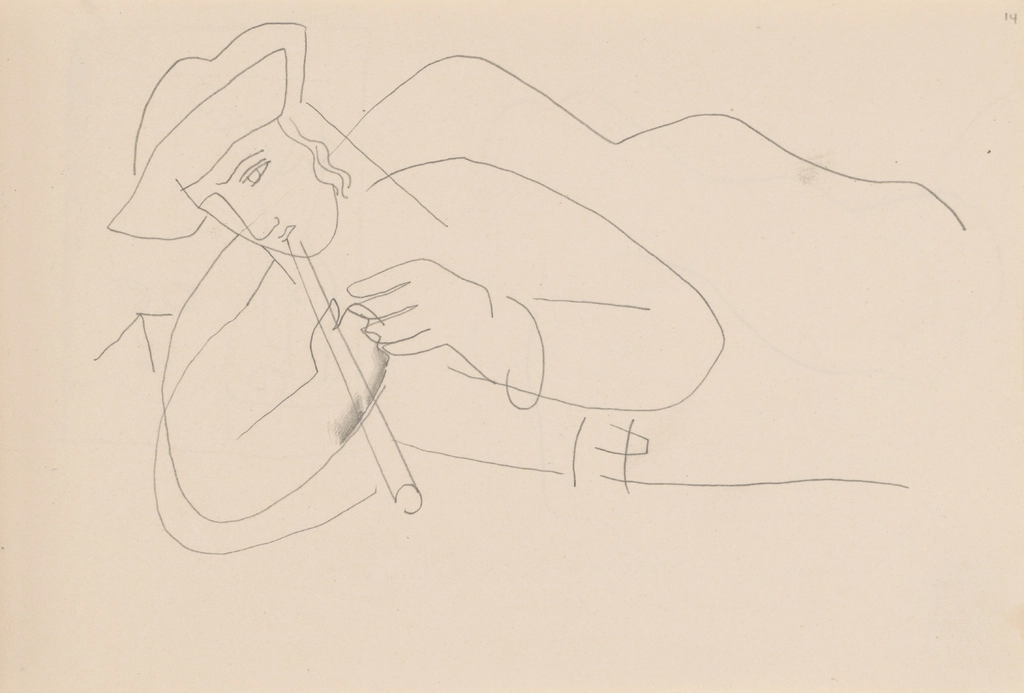
Artists can use the basic elements of a composition to establish direction. Lines and edges offer routes to follow, while relationships between shapes and colors can connect separate areas.
Directional lines and curves
A useful starting point is a visible route: a road, branch, ribbon, or abstract curve. You can also look for a direction suggested by several aligned forms rather than one continuous drawn line.
Try sketching the same arrangement twice. In one version, place three objects in a horizontal row; in the other, arrange them along a rising diagonal. Compare where you look first and how you move between them.
Repetition and changing intervals
Repetition creates relationships between visual elements, while rhythm gives those repetitions a sense of organized movement. Changes in spacing or size offer ways to vary that organization.
For a practical test, draw five circles with equal gaps. Underneath, draw five more with gaps that gradually narrow. Describe the difference without assuming one version must feel faster to every viewer.
Poses and repeated positions
A figure’s pose can suggest an action caught in progress. Another approach is to show successive positions together, as Giacomo Balla does with the repeated paws, tail, and leash in Dynamism of a Dog on a Leash.
For your own sketch, choose one action and one clear clue. A bent knee or trailing sleeve may communicate your intention more effectively than adding several unrelated motion marks.
Color connections and emphasis
Color can help guide attention between areas, while emphasis makes a particular area stand out. Movement and emphasis therefore work together, but they describe different aspects of the composition.
Pro tip: Before adding detail, draw a separate arrow diagram showing the route you want a viewer’s attention to follow.
Examples of Movement You Can Recognize
When studying a familiar artwork, separate observation from interpretation. First identify something visible; then explain how it suggests action or encourages your attention to travel.
Hokusai’s The Great Wave
In Hokusai’s The Great Wave, a huge curling wave rises above boats, while Mount Fuji appears much smaller in the distance. The wave’s circular forms contrast with the mountain’s triangular shape, giving you a clear starting point for discussing motion and stability.
Try following the wave’s outer contour with your eyes. Then look toward the mountain beneath its curve. You might describe your experience as a sweep around the wave followed by a pause at the distant peak; explain that as your reading, not a mandatory viewing sequence.
Balla’s Dynamism of a Dog on a Leash
Balla repeats the dog’s legs and tail, along with the leash and the walker’s feet, rather than presenting each in one fixed position. Those overlapping positions suggest rapid motion within a stationary painting.
A useful analysis would identify the repeated forms before describing the effect. Instead of writing only that the dog looks energetic, explain which visible repetitions make its movement convincing.
A mobile that changes position
A mobile offers a direct contrast with these flat images because its components actually move. You can observe the sculpture at different moments and compare the changing arrangement rather than imagining motion from a fixed representation.
For a viewing exercise, note one arrangement, wait, and describe what changes. Keep your observations separate from your interpretation of whether the movement feels gentle, irregular, or restless.
How to Identify and Describe Visual Movement
Use the following looking exercise with a painting, photograph, drawing, or poster. You do not need specialist vocabulary to make a clear observation.
- Record your first point of attention. Name the object or area you noticed before deliberately studying the image.
- Trace your next few stops. Note where you looked next and what seemed to connect those areas.
- Find visible evidence. Identify a curve, repeated shape, changing interval, or active pose.
- Describe the effect precisely. Try words such as sweeping, interrupted, circular, gradual, or abrupt when the image supports them.
A useful sentence structure is: “My attention follows the curved shoreline toward the boat, connecting the foreground with the distant water.” It names a feature, describes your viewing experience, and explains the relationship.
Avoid vague claims
Instead of “This picture has lots of movement,” ask what creates that impression. If you cannot point to a visible clue, look again before settling on your explanation.
Also distinguish observation from intention. “The repeated red shapes draw my attention across the page” describes your experience; claiming the artist intended a particular sequence needs additional evidence.
Separate movement from rhythm
Rhythm involves repeated elements creating an organized visual beat. Movement is the broader issue of suggested motion and the route through a work. When repetitions guide your attention, the two principles overlap.
Practice Creating Movement in Your Own Artwork
Try these exercises as experiments rather than recipes. Keep each version simple enough that you can identify what changed and compare the results.
Draw one subject in contrasting arrangements
Choose a tree, bottle, or simple figure. Draw one version centered and upright, then another tilted or placed off-center. Compare the direction of the main forms and ask which arrangement better supports your intended effect.
Build a route with a few shapes
Cut several circles and rectangles from scrap paper. Arrange them so you would like someone to look from one corner toward a chosen shape, then ask another person where they actually looked first.
- Change only the spacing and compare the result.
- Rotate one shape without moving the others.
- Replace one shape with a contrasting color.
- Remove an element and check whether the route becomes clearer.
Revise before adding detail
Choose your strongest arrangement and make a small finished study. Before adding texture or decoration, check whether you can still explain the intended direction in one sentence.
Save the earlier versions beside the final one. They give you concrete evidence of your decisions and make it easier to discuss what worked, what distracted you, and what you would change next time.
Frequently Asked Questions
What is a simple definition of movement in art?
Movement is the sense of motion in an artwork and the way your attention travels through it. It can come from an active subject or from the arrangement of visual elements.
What is the difference between movement and rhythm?
Movement concerns suggested motion and visual direction. Rhythm comes from the organized repetition of elements, which can help create movement through a composition.
Can a still-life painting show movement?
Yes, because movement does not require a physically active subject. Lines, edges, shapes, and colors can guide your attention through a still-life arrangement.
Is movement an element or a principle of art?
Movement is generally taught as a principle of art or design. It describes how visual elements are organized to guide attention, rather than being an element such as line or color itself.
Conclusion
Understanding movement begins with two questions: What seems to move, and where do your eyes go? Keep those questions separate at first, then look for places where their answers overlap.
Choose one artwork and identify a specific clue that supports your interpretation. Then test that idea in a simple sketch of your own. Start with a clear observation, and build your explanation from what you can actually see.